RangeMaster
Treble Booster
The thing about the legendary RANGEMASTER treble booster is that once people start using it, they find it very difficult to play without it.
Now, I’m not saying the Rangemaster is addictive and dangerous to experiment with, but, no, wait…that is what I’m saying.
HardWay Vintage Electronics produced six RangeMaster types, from Gen1 to Gen VI, probably about 100 units overall. The rarest Generation was Gen III, with only 8 made. All series (Gen I to Gen VI) sold out, and were discontinued.
I stopped making the RangeMasters because the supply of good Germanium transistors had dried up, and the Welwyn pots became impossible to find.
The HardWay RangeMaster is a very accurate reproduction of the original legendary Dallas Rangemaster Treble Booster of around 1966. Unit serial numbers are written on the bottom outside of the unit, and on the inside, near the terminal strip.
Dallas Rangemaster:
Excellent analysis of the Dallas Rangemaster:
https://www.electrosmash.com/dallas-rangemaster
The classic Dallas Rangemaster Treble Booster features a high voltage gain of approximately 38dB. This significant boost, combined with its upper-mid/treble frequency emphasis, is achieved through a single-stage, germanium-transistor-based circuit designed to push tube amplifiers into overdrive.
Not very many original Dallas Rangemasters were built (nobody knows how many) and they were hard to find, even in the 1960s, even in England, where they were made. Moving ahead to the 21st century, I saw one on eBay the other day, listed for $5,000. Nowadays, you can buy a modernized Rangemaster SMD circuit that is smaller than a postage stamp.
The Rangemaster was a very simple circuit, centered around a Germanium transistor (usually a Mullard OC44 or NTK 275 or a Mullard OC 71). The circuit consists of 1 transistor, 3 resistors, 4 capacitors, a potentiometer, a switch, and a battery.

The Welwyn preset pot was usually 10K or 20K. The boost knob was scratchy when adjusted, due to the DC voltage present on the pot. This is the way the original was designed; it is normal for this device.
Early units all use the Welwyn preset potentiometer as the boost control, as original. (Series III pots were all 25K Ohms, which make them a little “gainier” than the original when turned all the way up.
The (3) resistors are carbon composition. Two of these resistors are used to bias the transistor; their values will be different from unit to unit, because each transistor is slightly different and is biased to the middle of its range. The schematic of the RangeMaster is attached to the inside of the black cover; here you will find the gain measurements of the OC44 used in the device and the values of the bias resistors for that particular OC44.
Germanium transistors are temperature sensitive. I bias the transistors at 70 degrees F.
In the summer, or under hot lights, the temperature rises and the gain of the transistor will rise. Just something to be aware of. (This is true of the FuzzFace, another legendary vintage Germanium effect, and it has been said that Stevie Ray Vaughn liked his FuzzFace to be hot, so he could take advantage of the extra gain.)
The Germanium resistor is in a socket, so it is removable in the event of failure or if you want to change to a different transistor. For your information, the transistor should be inserted into the socket with the Collector leg (usually marked with a dot or a notch) on the left when looking at the face of the device. If you replace or change the transistor you must check the bias.
CHECKING BIAS:
(Use a fresh battery, unplug both jacks, turn unit off, remove cover.)
Set your DMM for DC Volts.
Attach the black (ground) lead to pin #1
(Facing the front of the unit, the terminal strip has 6 pins – numbered from left to right. The #6 pin is unused and is cut off.)
Attach the red (positive) lead to pin #3 (the collector leg)
Turn on unit.
You would like to see between -6.5 and -7.2 Volts (Remember the OC44 is PNP, so Positive ground)
If the measurement is out of range, either something is wrong, or you need to change the bias resistor values to bring it into range.
OPERATION:
The Boost control is sensitive, and as mentioned earlier, scratchy, so it, too, was meant to be set at the “sweet spot” and then left alone. Some nice distortion, gain, and harmonics are evident even at low Boost settings. Turning the Boost up just makes it more aggressive. And louder.
The RangeMaster is not exactly delicate, but it does not appreciate rough handling and dropping it or throwing it around can have negative outcomes. Warning.
Unplug your RangeMaster and turn it off when you are done playing with it. If you don’t, you will drain the battery, and then you will have to undo the 4 screws holding on the cover and replace the battery. This is a pain, so you will learn to turn it off when you are not using it. The 9V battery lasts a very long time if you keep it turned off when not in use.
The RangeMaster should be the only device between your guitar and your amp. Because it is a PNP device, and because of circuit peculiarities, it doesn’t do well when connected to other boxes. You won’t hurt anything if you try it with multiple devices, but you won’t like it.
OC44:

The Germanium transistor is highly unreliable, extremely temperature sensitive, unstable, leaky, prone to hum and hiss, and fails short if you look at it funny. It’s no wonder it was replaced as soon as possible by silicon.
Details:
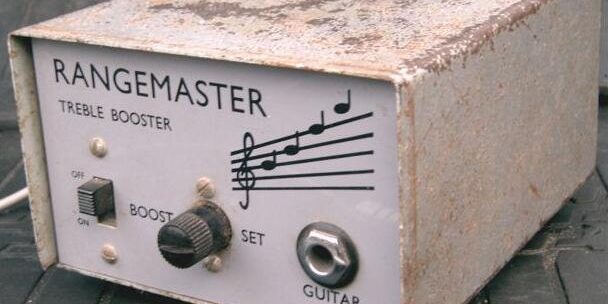
The Rangemaster’s primitive (and incorrect) G-Clef with a little arpeggio (in the key of Asia Minor) let the unfamiliar know that this device had something to do with music. The not-overly-complex RangeMaster had two controls: an on-off switch and a boost knob. The boost knob was quite noisy due to the DC voltage present on the Welwyn, so you were clearly supposed to set the boost where you liked it, and then NEVER TOUCH IT AGAIN. …unless you like the sound of frying bacon.
Pot

The peculiarly endearing potentiometer in the original Dallas Rangemaster was a UK Welwyn 10k ohm (sometimes 20k) unit with two mounting screws instead of the ubiquitous hex-nut-over-the-shaft arrangement of USA pots from that era. The Welwyn pot was cleverly isolated from the chassis of whatever it was mounted on; the potentiometer body was Bakelite or other thermoset, and the plastic knurled knob was non-conductive. Not that this isolation was necessary for the Rangemaster’s low-voltage, low-current signal, but it was distinctive and made the Rangemaster that much more novel.
There is a plethora of Rangemaster clones and near-clones and replicas and reproductions and tributes out there, but none of them employ a genuine isolated Welwyn potentiometer. Except HardWay RangeMasters.
Does the Welwyn potentiometer make a difference in the sound? Of course it does! It makes as much difference as cloth-covered wire versus plastic insulated wire. It makes at least as much difference in the tone as a vintage capacitor does compared to a new high-quality capacitor of identical capacitance and leakage. Ahem.
Germanium, from Germania
The highly regarded OC44 germanium transistor was just somewhat serviceable. A friend who worked for a manufacturer in the 60s told me that they had to do 100% testing of all the Germanium transistors because as many as 50% of them didn’t work when they were brand new. A lot of them would fail as soon as you tried to use them. To this day, you have to sort through hundreds of Mullard OC44s to find a handful that are usable in the range we are looking for.
[ A side note for you do-it-yourselfers: There are a lot of OC44s for sale on eBay and elsewhere. I have tried buying a lot of these and have usually been disappointed. Some of them are dead on arrival, some have abysmal hfe (20 !) some have spectacular leakage, and some are not OC44s at all, but SFT307s painted black (true). A good seller will tell you the leakage and the real hfe (not just the apparent hfe, which includes leakage) of each OC44, or he will be happy to find it out for you. If the seller says the transistors are “untested” you should assume that they have, in fact, been tested, and been found wanting at some point in their history. I’m not saying that these sellers are unscrupulous, I’m just saying that some of them seem unscrupulous.]
The OC44 Germanium transistor, besides being notoriously unreliable, did have some interesting compression and distortion characteristics when biased properly. Electrical engineers have long designed clever biasing circuits which completely ignored the range of hfe (amplification factor) of transistors, especially these transistors. So if an OC44 enthusiast tells you that his OC44 has an hfe of 175, and that it would be totally awesome in a Rangemaster, you can point out that any OC44 hfe between about 35 and 200 would be equally awesome in the Rangemaster circuit, due to the modulating effect of the bias circuit design.
Leaky, as in “they are all leaky”
Since high leakage can mask true hfe, and since all OC44s are leaky, unless you measure leakage of transistors separately from hfe, you will never really know the true amplification factor of your OC44.


(Endless testing of Germanium transistors for true hfe.)
https://web.archive.org/web/20141020184533/http://www.geofex.com/article_folders/fuzzface/fffram.htm
is an article by R.G. Keen about germanium transistors for the FuzzFace; a bit down the page is a method for measuring leakage and hfe, and a schematic for a true hfe measuring circuit you can build in about 10 minutes on a breadboard.
Regardless, the trick to the Rangmaster circuit is the bias circuit. The best Rangmasters are biased to about the middle of their range. In this way you get nice compression-like effect as well as pleasing distortion and attack sensitive response from the Rangemaster.
Biased improperly, the Rangemaster just sounds like a treble booster, which still isn’t bad, by the way.
The HardWay RangeMaster is a precise reproduction of the original. It is hand-made and each one is custom biased for each individual OC44 or other Germanium transistor.
The RangeMaster is not a stomp box. If you stomp on it, bad things will surely occur.
It sits on top of your amplifier. You plug your guitar into it, and you plug the RangeMaster into your amp. Extensive testing has shown that, like the original, the RangeMaster does not work and play well with others; If you have a big effects chain, and a colorful array of stomp boxes, and a high-tech effects loop in your amp, this is probably not the effect for you.
It is not so fond of solid-state amps, it will still work, but you won’t get the best performance out of the unit when plugged into a solid-state amp.
The RangeMaster uses a 9V battery, replaceable by removing the 4 screws on the case and lifting the lid.
Each OC44 in each RangeMaster is biased at a battery voltage of 8.5 VDC. This ensures that you will get optimum performance of your RangeMaster throughout the life of the 9V battery. A 9V “wall wart” supply is not an option; this is a PNP device. Almost all “stomp boxes” are NPN. They do not work and play well together.
As with the original, the boost control will make scratchy noises as it is turned. If you want a silent adjustment, look for a “modernized” Rangemaster.
HardWay RangeMaster Gen V
The Series V HardWay RangeMaster has three PNP Germanium transistor modules, selectable with a three-way rotary switch on the back of the unit. Each transistor module consists of the transistor, the bias resistors and a 50 µF capacitor. The three transistors included with the Series V RangeMaster are OC76, OC44, and AC125. The gain of the transistors used in this series ranged from 82 to 112. (True gain, which is apparent gain minus leakage.)

Series V also has a 3-way frequency cutoff selector switch on the back of the unit that changes the boost frequency from “Stock” to “Wide” or “Full”. The stock (middle) setting is as the RangeMaster was designed in 1966, a true treble boost. The upper “Wide” setting expands the boosted range to include more mid-range frequencies, and the lower “Full” setting boosts the entire range of a normally tuned guitar.
Series V units all use the Welwyn preset potentiometer as the boost control, as original. The pots are all 25K Ohms, unlike the original’s 10K Ohm pot. Unfortunately, I could not find any 10K pots anywhere, they may be extinct. As a result, you may find that much of the range of the pot is unusable due to noise. This crackle / fuzz noise is just too much gain – the normal noise is being amplified too much.
Try staying in the bottom 1/2 of the Boost control for best results. As mentioned earlier, the Boost control is noisy when turned, because of DC on the pot circuit. That’s normal. Welcome to 1967.
Each transistor is slightly different and is biased to the middle of its range. A schematic of the RangeMaster V is shown.


The transistors are in sockets, so they are removable in the event of failure or if you want to change to a different transistor. For your information, the transistor should be inserted into the socket with the Collector leg (usually marked with a dot or a notch) on the left when looking at the face of the device. (See diagram of the white socket seen from above).

If you replace or change the transistor it is not necessary to check the bias, but it is a good idea.
HardWay RangeMaster Gen VI
The GenVI was the last of the series, featured the 3-way Boost Frequency control, and used a modern 10k log pot. T1 is one of six Germanium transistors that work well with the RangeMaster. The schematic and other data is below:


You can make your own HardWay RangeMaster Gen VI by following the above layout and the parts list, below:

HardWay RangeMaster Gen. VI 2020 Parts List
Component Part Number*
Resistors
1%, 1/4-watt metal film resistors
(1) – 470K 271-470K
(1) – 68K 271-68K
(1) – 3K9 271-3.9K
(2) – 2.2M 271-2.2M
Potentiometers
(1) – 10K or 20K audio taper pot, 16mm 858-P160KNP0EA15A20K
Capacitors
(2) – 47µF electrolytic 140-XRL25V47
(1) – 0.047 polyester film AES C-PFD047-50-R
(2) – 0.01µF polyester film AES C-PE1D01-100
(1) – 0.005µF polyester film AES C-PE1D0047-100
Transistors
(1) – Gain tested PNP Germanium, like Mullard OC44 or OC71 or other.
(Hard to find. Try eBay or Small Bear Electronics.)
Other Parts
(1) – Hammond 1590BB enclosure 546-1590BB
(1 or 2) – Cliff jack, ¼” AES S-H901-X
(1) – DPDT Slide Switch AES W-SC-W10
(1) – SPDT 3-position toggle switch, mini 633-M2012WBW01
(1) – 24 gauge white stranded wire 100 ft. 602-3050-100-01
(1) – Plastic knob, black AES P-K801
(1) – Battery snap, 6″ leads AES K-P155
(4) – 3M stick-on rubber feet, black 517-SJ-5012BK
* Part Numbers are Mouser Electronics, unless noted AES = Antique Electronics Supply.
NOTES:
The original Dallas Rangemaster used carbon composition resistors. They are noisy and are usually 20% accurate. Modern metal film resistors are quiet and 1% accurate.
The output of the Dallas Rangemaster was a coaxial cord with a male ¼” jack. You can change this to a ¼” Cliff jack for a more modern output.
WARNING:
I will warn you in advance of two things of which I am certain:
1. This device is addictive – you may find it difficult to turn off.
2. Eric Clapton did not use a Rangemaster on the Beano album.