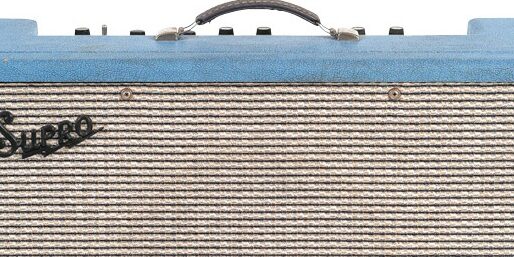
A customer brought in a Supro Model 24 amp for service. The customer reported that smoke came out of the amp and smelled bad. Never a good sign. It didn’t work.
The Supro Model 24 was produced from 1959 – 1967. This one appears to be the 1965 model, covered in Calypso Blue vinyl (which matched the color of the Supro Super Seven guitars of the era.) The transformers, potentiometers, switches etc. seem to be original. The amp is in fair to good cosmetic condition and is missing the original handle.
This amp is reportedly the one used by Jimmy Page to record Led Zeppelin I. Page recalled only that the amp was a small, blue Supro 1 X 12” combo amp. There are plenty of people who say that it was not this amp. So, maybe or maybe not. For whatever reason (perhaps the amp’s great tone), the Model 24 is highly sought after.
The Model 24 featured three 12AX7 preamp tubes, two GE 6973 cathode-biased output tubes, and a 5Y3GT rectifier. Controls are Volume and Tone on each of two channels, and Tremolo Speed and Intensity. Most of the tone and coupling caps are ceramic discs, as original.
The unusual 6973 output tubes give the amp a thick, gritty tone and pleasing distortion. Also, the amp runs at lower voltages than typical amps of the day, which also contributes to its great tone.
The amp was rated at 18 Watts, through a Jensen Special Design C12Q or C12R.
(This amp has a Jensen Special Design C12R that is dated 1965.)

ASSAY and WORK:
The tubes tested as follows on the TV-7D/U:
TUBE TYPE MFG. MIN. VALUE ƒ VALUE
- 12AX7 RCA (32) 1st Gain 50/52
- 12AX7 RCA (32) Phase Inv. 57/48
- 12AX7 RCA (32) Trem 55/58
- 6973 U/K (24) Output 31 *
- 6973 U/K (24) Output 30
- 5Y3GT RCA (40) Rect. 53/58 **
* Missing pin #8.
** Cracked base. (This does not affect the function of the tube, but care should be taken when removing or inserting the tube.)
The preamp tubes and the rectifier are all RCA USA tubes, of great quality.
The #2 12AX7 is somewhat unbalanced, so I swapped its position with #3, the Tremolo tube, where the mismatch doesn’t matter. The better matched tube should be in the phase inverter tube position, which is the hardest working tube in the amp.
A new 3-conductor power cord was installed. The “Death Cap” was removed. The fuse was moved to the line side of the input (125 VAC), followed by the switch.
On examination, the chassis was rather dirty. The 1st dropping resistor had obviously failed – it was in two pieces. The #1 6973 tube was missing pin #8, which is the pin for the screen grid of the tube.
The 6973 screen grid normally operates at 350 VDC. With the loss of the pin, the screen was at zero volts and thus the tube was just barely working, if at all.
The amp is cathode biased and the two tubes share a common cathode resistor. With one tube with no screen voltage, the remaining tube ran way too hot (far above 100% dissipation) and caused the failure of the power supply 1K dropping resistor. The 1-Watt resistor exploded and broke into two pieces. This was the source of the smoke and the smell.
Electro-Harmonix makes a reissue 6973 tube. This is a “real” 6973, not a re-brand of a “close” tube. A matched pair costs $73.20. The new 6973s were installed. The tube sockets were very loose and were tightened. Jacks were cleaned.

The multi-section can capacitor (filter capacitors) was bad for ESR and DCR and was replaced with a similar can capacitor, but at a higher rated voltage (525 VDC vs. 450 VDC.) These filter capacitors should perform better and last longer.
The RF shield of the Channel #2 inputs had a broken ground on the Low input and was repaired.
The speaker was disconnected in order to troubleshoot the chassis and was tested to determine its polarity (which pole was positive.) A parallel speaker output was added to the amp at some point. Connecting an additional 8 Ohm speaker cabinet to this amp would change the speaker load to 4 Ohms – this is a mismatch between the amp output transformer and the speaker load. It’s not recommended for the long-term, but a lot of people run two speakers for years without problems.

BIAS:
The bias was measured at 347 VDC plate voltage, and a 23 V drop across the 250 Ohm cathode resistor. The 6973 output tubes are rated at 15 Watts. The bias was running the tubes at right about 100% of their capacity. Because this amp is cathode biased, the bias is within range of specification.
SUMMARY:
The amp is not particularly loud, as is typical of the Model 24. Jimmy Page mic’ed the amp and placed another microphone across the room in the studio, which gave a kind of natural reverb. The distortion, however, is great when the volume is at maximum. The Treble input of Channel #2 has great tone. Play a open E power chord (E5) hit hard and muted quickly and you hear the Jimmy Page tone of “Good Times Bad Times” on Led Zeppelin I.
VALUE:
The 1965 Calypso Blue Supro Model 24 amplifier is somewhat rare and highly desirable, especially with Jimmy Page enthusiasts. Asking prices seem to range from $1400 to $2000. I couldn’t find any, in any condition, for less than $800.
These are asking prices. I would value this amp at $1700 to $1900. This is just my best guess – I am not an appraiser.
Here is the schematic with repairs and changes. Note the unusual “Grid Interrupt” standby switch circuit.